Are you thinking about traveling or moving to the Philippines? If you are, you might have decided to learn Tagalog so you can socialize with Pinoys in no time.
But when you browse official websites and sign up for an online course, you’ll see Filipino. So, is Filipino the same as Tagalog?
Whether you’re a tourist, an expat, or just curious about the Filipino language, it is important to have access to reliable translations. Translations provide you accurate and culturally relevant learning materials. Our professional Translation Service Washington DC can help you with everything from legal document translation to everyday communication.
To truly understand the difference between Tagalog and Filipino, you have to understand the history behind the languages.
What’s Tagalog? The Native Tongue of Southern Luzon
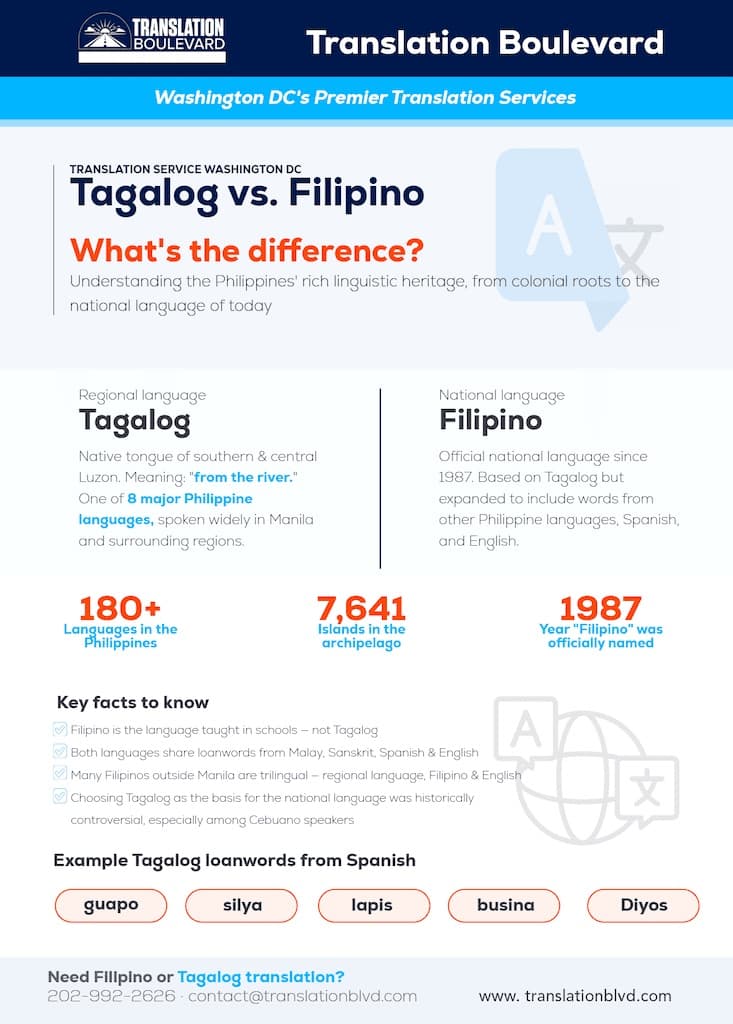
The Philippines is one of the world’s most linguistically diverse countries, with over 180 distinct languages spoken across its 7,641 islands. Of these, Tagalog is one of the eight major regional languages while Filipino is the national language.
Tagalog is the primary language in the southern and central regions of Luzon, including the capital city Manila. The word “Tagalog” is short for “taga ilog,” which translates to “from the river.”
Scholars debate which river it refers to, but many speculate it’s the Pasig River that flows through Manila and empties into Manila Bay. Long before the term “Filipino” was coined, the people of this region were already speaking Tagalog.
If you’ve ever come across books on Philippine history written in Tagalog, you can always trust our Translation Service Washington DC to provide precise translations that preserve the richness of the original text.
What’s Filipino? The National Language with a Long Backstory
Filipino is the official national language of the Philippines. The language was based on Tagalog and meant to represent the country as a whole. Its origins are rather controversial, but looking at the roots of Filipino can help you understand its history.
When Spain established its first settlement in Cebu in 1565, the Philippines had no single language to unify its diverse inhabitants. The lack of a unifying language is no surprise given that the archipelago is made up of thousands of islands.
By 1571, Spain declared Manila the capital and primary hub of colonial administration, while Cebu continued to advance as a vital trading and administrative center. Spain also expanded its influence to Iloilo, Vigan, and Zamboanga.
When Speaking Spanish Meant Status
During this period, the sprawling archipelago finally had a name, Las Islas Filipinas. Spanish was introduced as a prestige language reserved for the upper class who sought stronger political connections, social status, and greater fortunes. On the other hand, the masses who lacked formal education continued to speak their native tongues.
But as the Spanish era drew to a close, a new colonial power was about to reshape the Philippines’ linguistic, educational, and political landscape…
On May 1, 1898, the United States Navy under Commodore George Dewey destroyed the Spanish armada during the Battle of Manila Bay. This hastened the end of the Spanish-American War and over 300 years of Spanish rule in the Philippines.
Shortly after Spain’s defeat, the United States colonized the Philippines. But unlike the Spaniards, who kept Spanish exclusive among themselves and wealthy Filipinos, the Americans sent hundreds of teachers to teach English (the famous Thomasites), which quickly became the new language of administration, education, and law.
While it’s true that the Americans defeated Spanish rule, the Philippine Revolution had already begun years before their arrival. You may have heard of Jose Rizal, the country’s National Hero, whose writings ignited a desire for reform and encouraged nationalism.
Rizal authored two influential novels, Noli Me Tangere and El Filibusterismo, to expose the injustices of Spanish colonial society and inspire reform through education and unity. These novels were originally written in Spanish and later translated into Filipino.
If you wish to explore these masterpieces and understand the powerful ideas that fueled a revolution and immortalized Rizal as a hero, you can trust our Translation Service Washington DC to render them into English while preserving their authenticity and emotional depth.
Tagalog as the National Language Ruffled Feathers
In August 1916, the Jones Law promised the Filipino people eventual independence if they could prove that they could govern themselves.
Nearly two decades later, the Tydings–McDuffie Act set the framework for a 10-year transition period under a Commonwealth government, with Manuel L. Quezon as president.
As was expected, the new government faced major challenges, including the struggle to unify the country through language and cultural identity.
In 1937, Quezon created the National Language Institute, which recommended Tagalog as the basis for the national language. This decision, however, did not please non-Tagalog speakers, especially those from Cebu.
To Cebuanos, choosing Tagalog seemed like favoritism, and they argued that Cebuano deserved equal consideration as the national language because it was the most widely spoken regional language.
This debate persisted for decades.
A Language Meant to Unite a Nation
To address the divide, the 1973 Constitution declared both English and Pilipino as co-official languages. Later, the 1987 Constitution changed “Pilipino” to “Filipino” with an F, symbolizing a language that would continue to evolve. Filipino incorporates several new letters, including C, J, Z, X, Q, F, and Ñ.
The vision for Filipino was not to remain a language confined to Tagalog but to evolve into a dynamic amalgamation that embraced elements from other Philippine languages and reflected the nation’s diversity.
An example of this is the word “manong,” which is an Ilokano term that functions as an honorific for an older brother, cousin, or any male relative. Over time, “manong” has become firmly embedded in the broader Filipino lexicon.
True or False: Is Tagalog a “Pure” Language Unlike Filipino?
Some people online like to push the idea that Tagalog is a “pure” language. While it’s true that Filipino has many loanwords, it is an erroneous idea that Tagalog never had any borrowed words.
In linguistics, the notion of a “pure” language is a myth because every living language evolves, borrows, and adapts.
Tagalog has Austronesian roots and has absorbed influences from Malay and other neighboring languages. Consider words such as abante (from Spanish avante, “advance”), busina (from Spanish bocina, “car horn”), and Diyos (from Spanish Dios, “God”). Everyday vocabulary also reflects this borrowing: guapo, queso, lapis, miembro, paprika, policía, sueldo, tsinelas, silya, and countless others.
Acknowledging these loanwords is not a weakness but a testament to Tagalog’s dynamism. Borrowing doesn’t diminish a language’s identity; rather, it enriches it.
Even Tagalog words that have been considered “deep” or “native” have external origins: makata (from Sanskrit kathā, “story”), paksa (from Sanskrit pakṣa, “topic”), usap (from Malay ucap, “to speak”), and luwalhati (from Malay luwar + hati, “glory”). In fact, much of Tagalog’s lexicon is a mosaic of Malay, Sanskrit, Hokkien, Spanish, English, and more.
Thus, the claim that Filipino borrows while Tagalog does not is misleading. Both are products of centuries of linguistic exchange, and their richness lies precisely in this history of borrowing and adaptation.
Why Do People Say Tagalog or Filipino Interchangeably?
Many people use Tagalog and Filipino as if they mean the same thing, and in everyday conversation, that’s generally accepted. This overlap mostly comes from the strong influence of Tagalog on the Filipino language itself, which makes the distinction less obvious, even to many Filipinos.
To unpack that a bit, Filipino is the national language and the one officially taught in schools, not Tagalog. However, Filipino is largely based on Tagalog, which is why they often sound nearly identical in casual use.
Still, Filipino is meant to be broader and more inclusive, incorporating words and structures from other Philippine languages as well as foreign influences like Spanish and English.
Because of this, some terms exist in formal Tagalog that don’t always show up in everyday Filipino. For instance, what many would casually say as “solusyon sa problema” in Filipino could be expressed in more traditional Tagalog as “kalutasan sa suliranin.” That second version is technically valid, but it tends to sound formal or unfamiliar, especially to non-Tagalog speakers.
Outside the Tagalog-speaking regions, a lot of Filipinos grow up trilingual; they speak their regional language at home, learn Filipino in school, and use English in education, media, and work.
While many can understand and speak Filipino, they default to their native language in daily life unless they’re in places like Metro Manila where Filipino (and Tagalog) dominates.
Although there’s a difference between Tagalog and Filipino, this everyday mixing and switching between languages further blurs the line and makes the two terms feel interchangeable in practice.
Filipino vs. Tagalog: Which Should Travelers and Expats Learn?
For travelers and expats, this linguistic flexibility works in your favor. English is widely spoken across the Philippines, so you can get by comfortably in most situations.
That said, if your goal is to build deeper connections or settle into a specific community, learning the local language makes a big difference.
For example, if you’re planning to live in parts of Mindanao, picking up Bisaya (Cebuano) will help you navigate daily life more naturally and connect with people on a more personal level. You’ll feel like a local superstar to boot!
And if you’re preparing official paperwork, contracts, or study materials before your journey, consider using our professional Translation Service Washington DC to ensure everything is properly localized and legally compliant.
Please visit our website to find out more about our Translation Service Washington DC. You can also contact our Translation Service Washington DC at 202-992-2626 or contact@translationblvd.com.