
Russian ranks 8th on the list of most spoken languages worldwide, with more than 154 million native speakers and 260 million speakers all over the globe. In addition to diaspora communities worldwide, you can hear Russian spoken in Belarus, Poland, Kazakhstan, and Ukraine. It belongs to the East Slavic language group and has developed a unique identity of its own through years of cultural, economic, and political development.
Russian has gained popularity due to being the language of literary classics such as Fyodor Dostoevsky and Leo Tolstoy. Still, it has many peculiarities that make it a fascinating subject for language enthusiasts and translators worldwide.
There are plenty of translation services that handle the East Slavic language group, including Russian. Yet, due to the complexities of this language, you really need to make sure the professionals you hire are skilled Native speakers who understand all its intricacies.
So, what makes Russian so special? And how can our Translation Service Washington DC make a difference?
Russian Is the Language of Space
At our Translation Service Washington DC, we understand the importance of learning a widely spoken language like Russian — but did you know that it’s also obligatory for astronauts to learn it? Back in the days of the Soviet Union, the Russian language dominated space exploration. Ever since Yuri Gagarin was sent into space in 1961, Soviet (and later Russian) spacecrafts have been at the forefront of spaceflight development.
The International Space Station is not solely Russian; it involves other countries as well. Still, because Russia has left such a huge footprint in space, Russian has become one of the primary languages for all kinds of space operations. Astronauts who train for missions on the ISS may be required to learn Russian. There are a few reasons for that:
- Communication with Russian crew members
- Some spacecraft systems are in Russian
- Training takes place in Russia
As a rule, astronauts aren’t required to be fluent in the language, but they need to understand technical terms to navigate critical scenarios.
It Uses Diminutives… A Lot
If you’re acquainted with the Russian 19th-century classic, War and Peace, written by Leo Tolstoy, you might have noticed that all the characters in the novel seem to have at least a few names. Natalya can turn into Natasha, Konstantin can become Kolya, Sofiya may be called Sonya, and so on.
Some names may have even more cute nicknames and alternatives! In Russian, there are both formal and informal variations of names, as well as standardized nicknames that are generally accepted but used for different occasions. For example, a mother can call her son Kolya or Kolyenka for an even cuter effect, but at his job, he will be called his full name – Konstantin.
A beautiful name like Ekaterina (the Russian equivalent of Catherine) can take many forms: Katya, Katyusha, Katyenka, Katyushenka, or even Katyushechka. When using diminutives, you must be careful because, for the most part, they reflect a certain amount of intimacy and shouldn’t be used randomly by strangers. If you need to learn more about Slavic languages and their translation, feel free to contact our Translation Service Washington DC.
English Has a Lot of Borrowed Russian Words
Some Russian words have infiltrated the English language, becoming almost instantly recognizable. Some of the words relate to politics and economics, while others came via literature and culture. Let’s have a look at some of them:
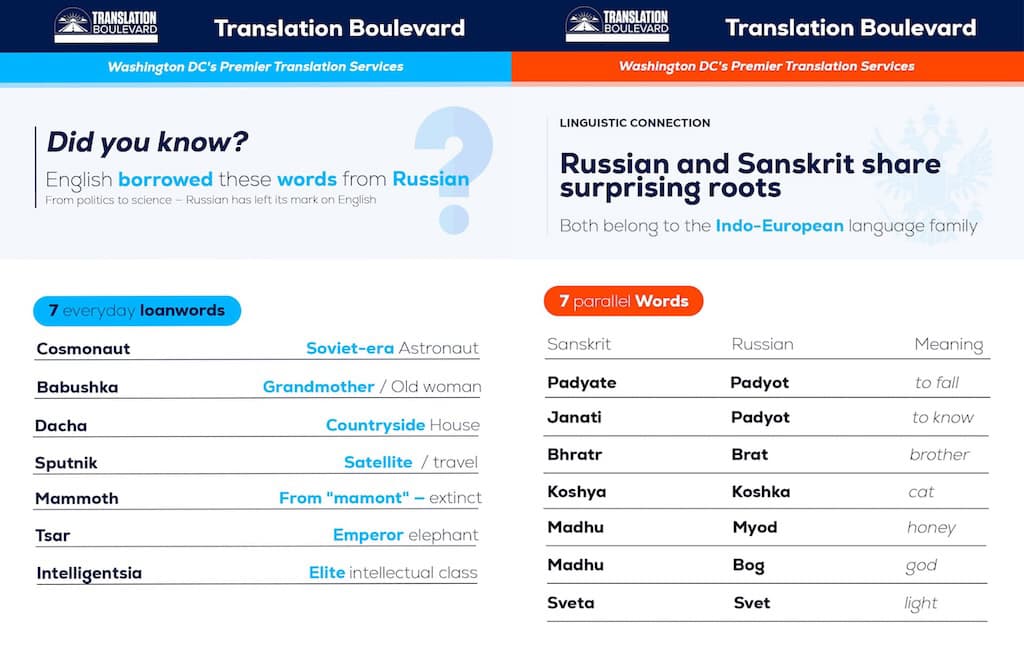
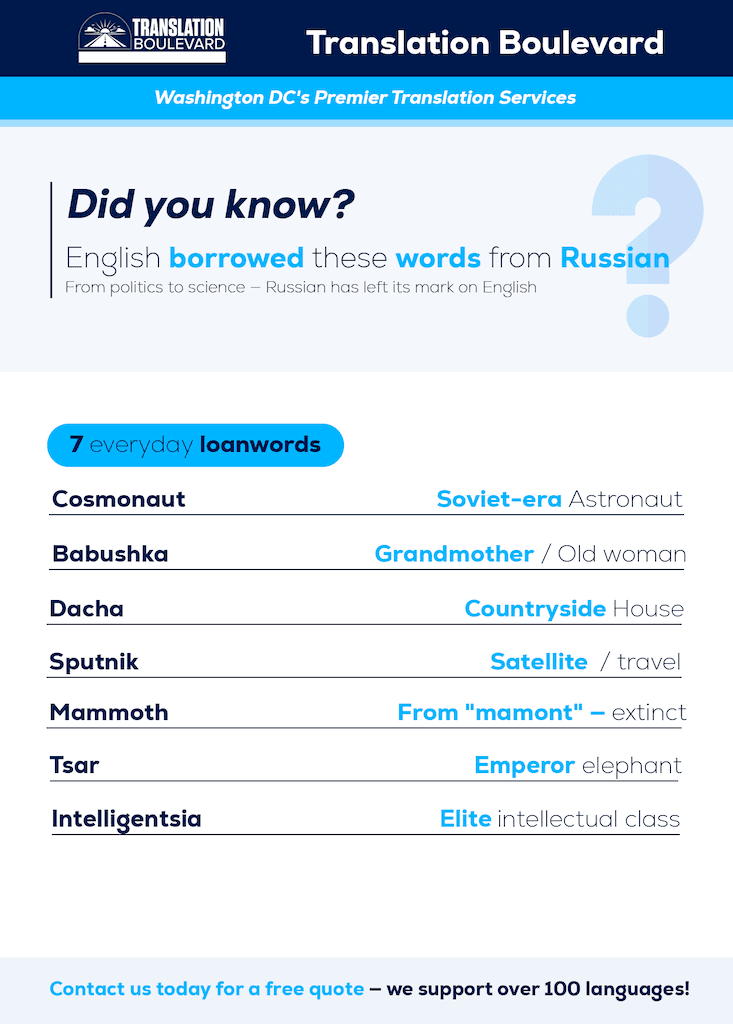
- Cosmonaut – a name for the astronaut in the former Soviet Union.
- Babushka – an old woman or grandmother.
- Dacha – a house in the countryside.
- Sputnik – a satellite or a travelling companion.
- Mammoth – derived from the Russian word “mamont” meaning the extinct species of elephantine mammals.
- Tsar – a Russian term for ’emperor.’
- Intelligentsia – a word describing an elite group of influential intellectuals.
For more information about Russian and other Slavic languages, feel free to contact our Translation Service Washington DC. A team of qualified linguists will help you with any project or task.
Russian and Sanskrit Have Similarities
It’s not unusual for Slavic languages to share some words with Sanskrit, and Russian is no exception. Both Russian and Sanskrit are part of the Indo-European language family. Dr. Weer Rajendra Rishi has made an entire study on the matter, and in his book India & Russia – Linguistic & Cultural Affinity, he has mentioned the many similarities between the two languages, including grammatical rules. Some rhythmic patterns are very similar in both languages as well. Let’s take a look at some words that illustrate how much Russian and Sanskrit have in common:
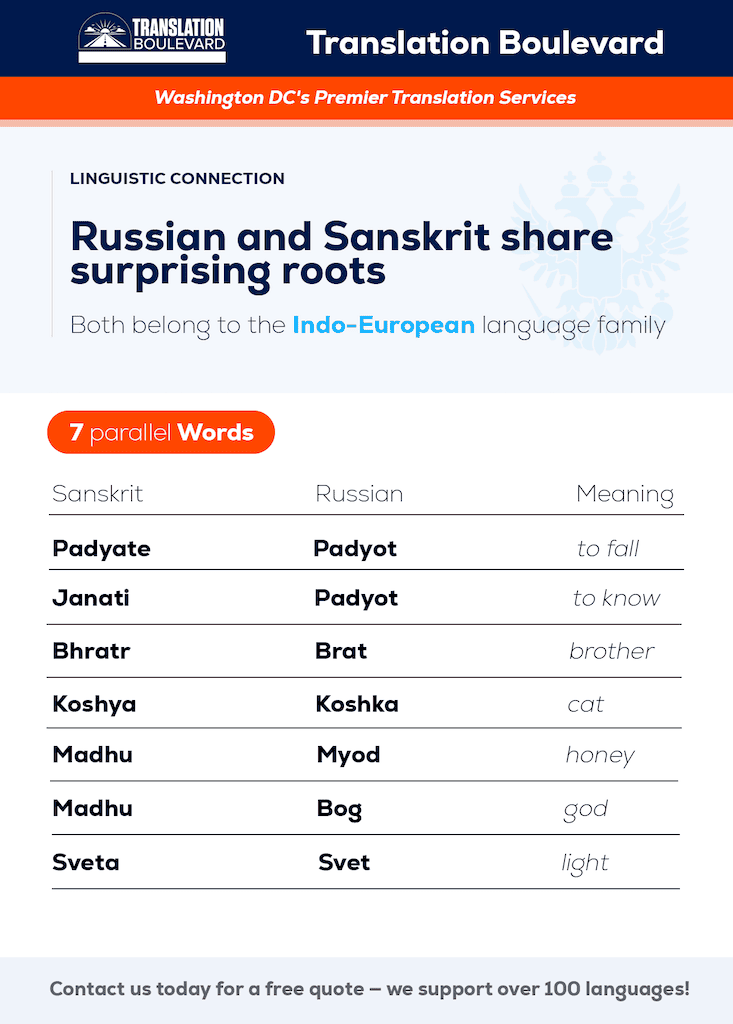
- Padyate (Sanskrit) – padyot (Russian) – to fall
- Janati (Sanskrit) – znayet (Russian) – to know
- Bhratr (Sanskrit) – brat (Russian) – brother
- Koshya (Sanskrit) – koshka (Russian) – cat
- Madhu (Sanskrit) – myod (Russian) – honey
- Bhag (Sanskrit) – bog (Russian) – god
- Sveta (Sanskirt) – svet (Russian) – light
According to Dr. Rishi, the speakers of Sanskrit and Russian must have lived in proximity to each other at some point in history to share so many similarities. Sculptures of ancient Indian gods found on the territory of Central Asia suggest that Hindu culture, along with its language, must have spread far beyond India’s borders. If you’re interested in learning more about Slavic languages or have a project that needs translation, don’t hesitate to contact our Translation Service Washington DC.
Conclusion
Around 260 million people worldwide speak Russian, with four countries having it as their official language. Apart from Russia, you will also hear Russian spoken in Latvia, Moldova, Estonia, Ukraine, Uzbekistan, Turkmenistan, and many other countries. This language uses the Cyrillic alphabet and is known for its extensive literary heritage, including the works of such prominent writers as Tolstoy, Dostoevsky, Pushkin, Chekhov, and Bulgakov.
Russian is also considered to be the language of space, as the former Soviet Union used to dominate this field in the past. As of today, astronauts who work on the ISS might still be required to learn the language.
Our Translation Service Washington DC offer translation of Russian media and content, as well as materials in other Slavic languages. Our linguists are well-versed in the cultural intricacies of Russian and provide the most professional translation services with high attention to detail.