

Fun Facts About Different Languages: Do You Know Chinese Characters Contain Biblical Truth?
You may be surprised by the title of this article thinking, “Is it true that Chinese characters contain some truths known in the Bible today?” There is a famous Chinese idiom 仓颉造字,泄露天机 (Cang Jie Zao Zi, Xie Lou Tian Ji) which means “when Cang Jie created the Chinese characters, it revealed the secret of heaven”. Nobody knows for sure who Cang Jie was, but the Chinese folklore about Cang Jie suggests that he was the one who created the Chinese characters. But it is true that many Chinese characters contain hidden truth also found in the Christian Bible. In this short post, I will give you some examples that may make you wonder.
One of the most fascinating words in Chinese that potentially reveals Biblical truth is the word “boat”(船) . In Chinese, this word “boat”(船) is composed of three parts. On the left is “boat” (舟). There are two kinds of boats this can refer to. The former usually refers to a larger boat. The latter refers to a smaller boat or functions as a Chinese radical to represent any objects related to the boat. So 舟 here is used as a Chinese radical to refer to things related with a boat.
On the top right of the word 船, it look like the part 几 (several) in the modern simplified Chinese character. But in historical records, it was mostly written as 八 (eight). On the bottom right is the character 口 which means “mouth.” When Chinese speakers talk about how many people there are in a household, they will literally ask you, “how many mouths of people do you have in your household?” So “mouth” here refers to people or the number of people. So, in this case, when you have a boat with eight people, it’s considered a large boat or an Ark.
In modern Chinese, the word “Ark” was translated as “方舟” (a ‘Square boat’ if you translate it literally). But in the long history of China, the word “船” has been used to refer to a boat.
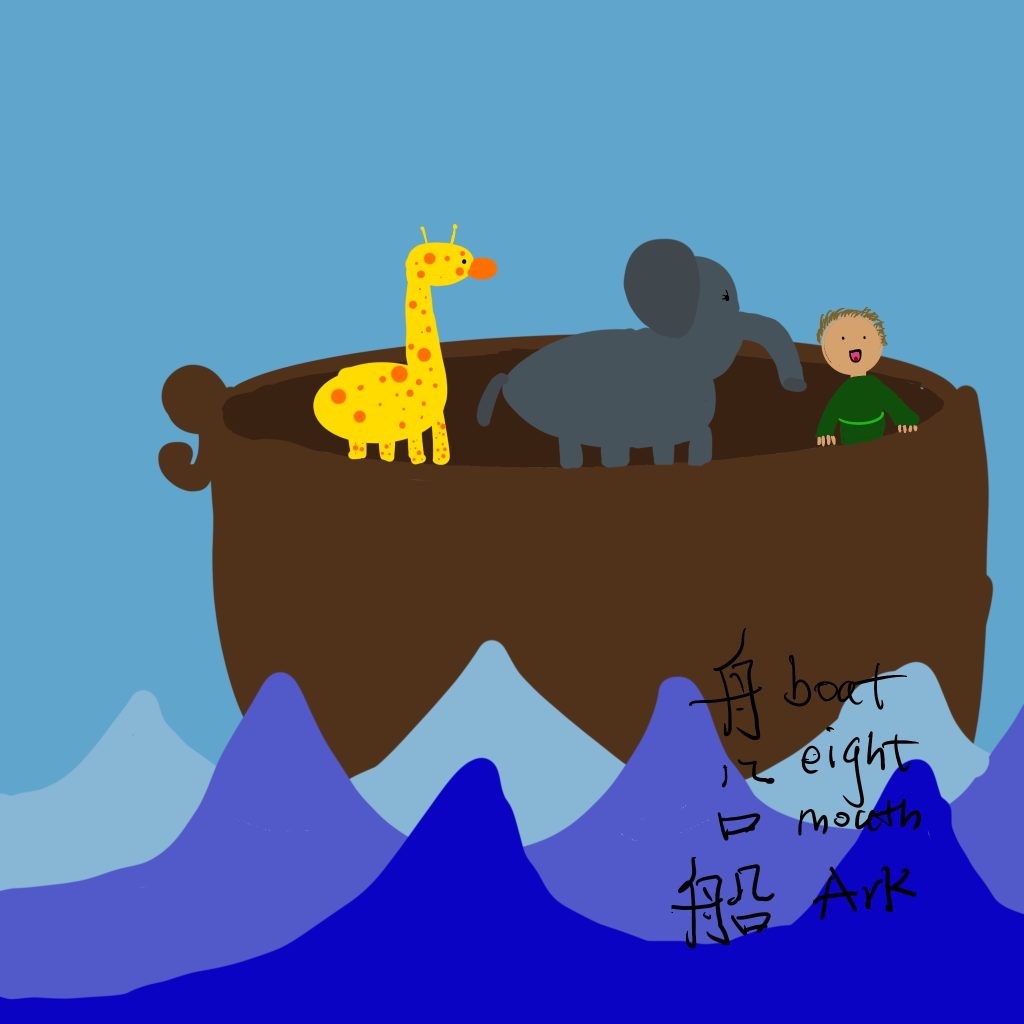
(I asked my 9-year-old daughter, Elim, to draw a picture based on the Chinese character for “boat” and the story of Noah’s Ark from the Bible. I wrote out the Chinese characters and labeled its parts with their English meanings.)
It is intriguing that ancient Chinese symbol associated the boat with the number of eight people—or eight mouths—on it. Why might that be? We are exploring a possible connection between Chinese characters and ancient Chinese culture and the monotheistic God of the Bible. Many people believe that ancient Chinese persons may have worshipped one God before the introduction of other religions, including Buddhism, which came to China around 2,000 years ago. China has a history of 4,000–5,000 years of oral and written tradition so it is possible that the ancient Chinese worshipped the true God and retained some revelation about him.
There is no coincidence… at least not this much. There are too many Chinese characters that seem to contain truths also revealed in the Bible to dismiss them all as coincidence.
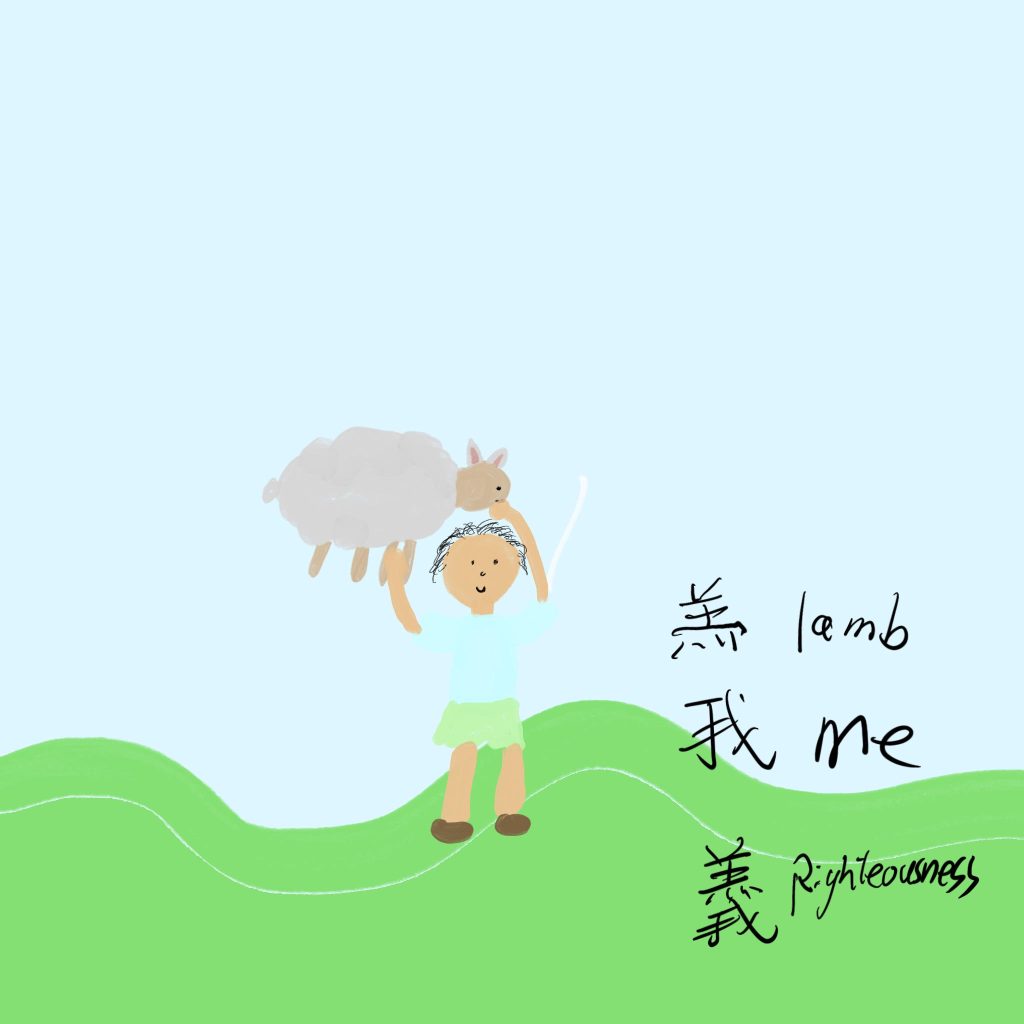
Another example is the word “righteousness.” In traditional Chinese, this word is 義, which is composed of two Chinese characters. The top is the character 羔 which means “lamb.” The bottom part is 我, which means “self” or “me.” When the lamb covers me or myself, that is righteousness. We all need this covering—but how did the ancient Chinese come to express such an idea?
I can give you hundreds of examples like these. I believe the ancient Chinese may have worshipped the triune God and retained some knowledge consistent with what we now find in Scripture, until that understanding faded over time. Even if we say the Chinese language was passed down through the oral traditions of ancient Chinese people, how did they know these things when the Bible had not yet been fully written or compiled?
(This was drawn by my daughter, Elim, and illustrates the Chinese character for “righteousness,” with “lamb” on the top and “me” on the bottom.)
I will give one more example. The word “greedy” in Chinese is written as 婪. The top part, 林, means “two trees,” because it is composed of two 木, which each mean “tree. The bottom part is 女, which means “woman.” In this way, “greedy” in Chinese can be depicted as a woman standing before two trees. This imagery may call to mind Eve in the garden who was faced with a choice between the trees. Was it desire and longing that led her to eat from the tree of the knowledge of good and evil? I believe so.
Chinese characters were created thousands of years ago. How and why did they develop this word without access to the biblical texts as we know them today? One possible explanation is that they preserved fragments of truth about God through oral tradition.
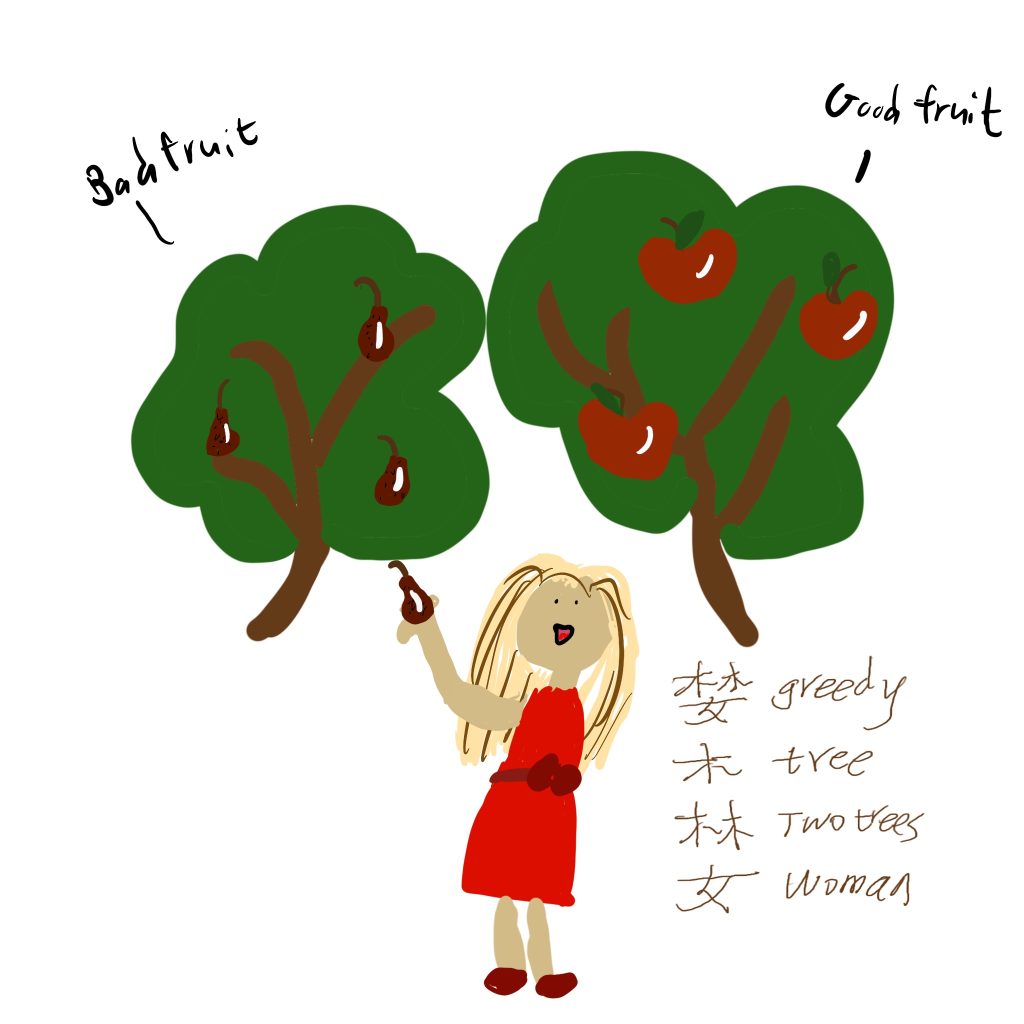
(My daughter drew the Chinese character for “greedy,” which is composed of two trees on the top and one woman beneath them. She marked the pear as the bad fruit and the apple as the good fruit.)
Here is one more example. The word “create” in Chinese is 造, which is composed of 走 (“walk”) on the left and 告 (“speak”) on the right. When God speaks, creation comes to life and moves.
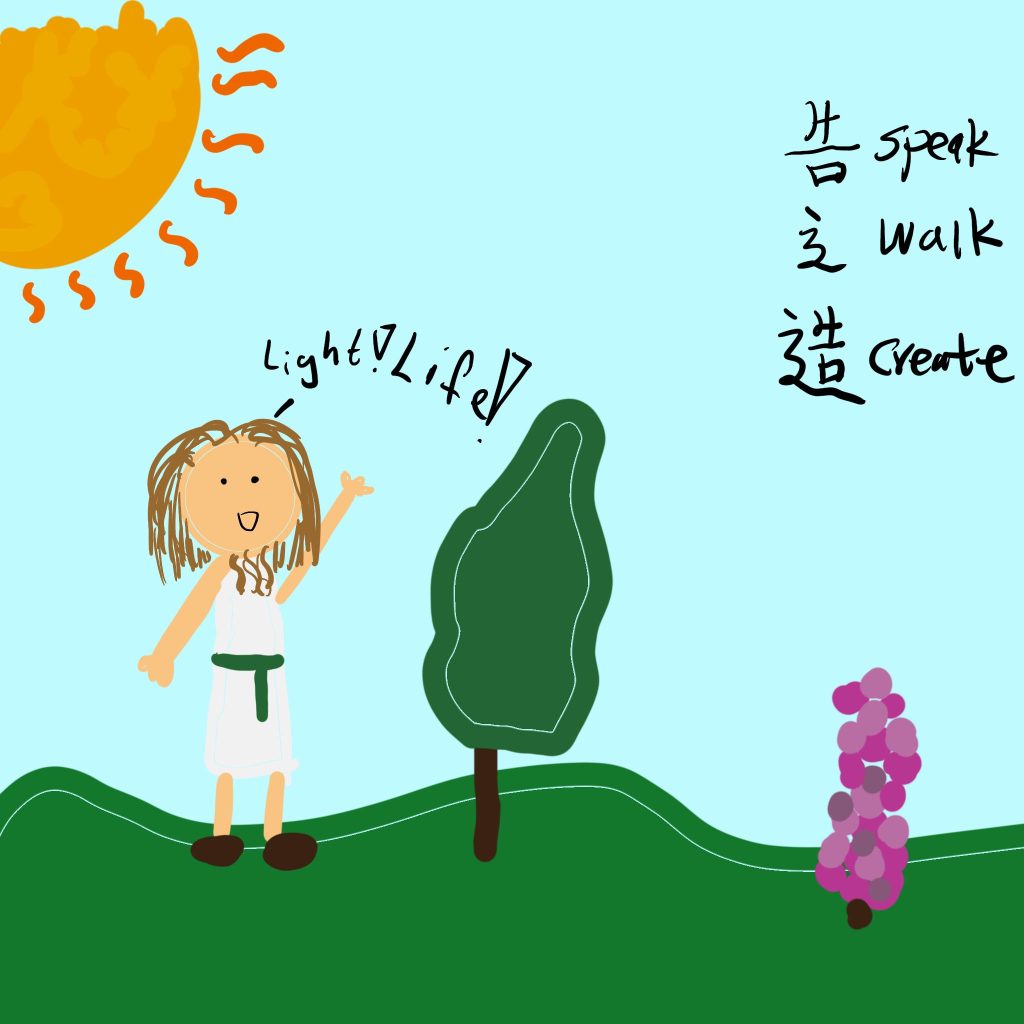
(My daughter drew the character for “creation.” I asked her to use her Bible knowledge and imagination to create this picture. She drew God on the left, saying, “Light! Life!” Then trees and flowers appear on the right. I asked her, “Where are the animals and humans?” She said there was no place to put them, but you can use your imagination—they are beyond the flowers, having walked so far that you cannot see them in the picture.)
This is the very last example for today. The word for God (神) is composed of two parts. On the left is 礻, referring to God, and on the right is 申, meaning “to speak” or “to declare.” God is a God who speaks—a God who reveals. When he speaks, things happen.
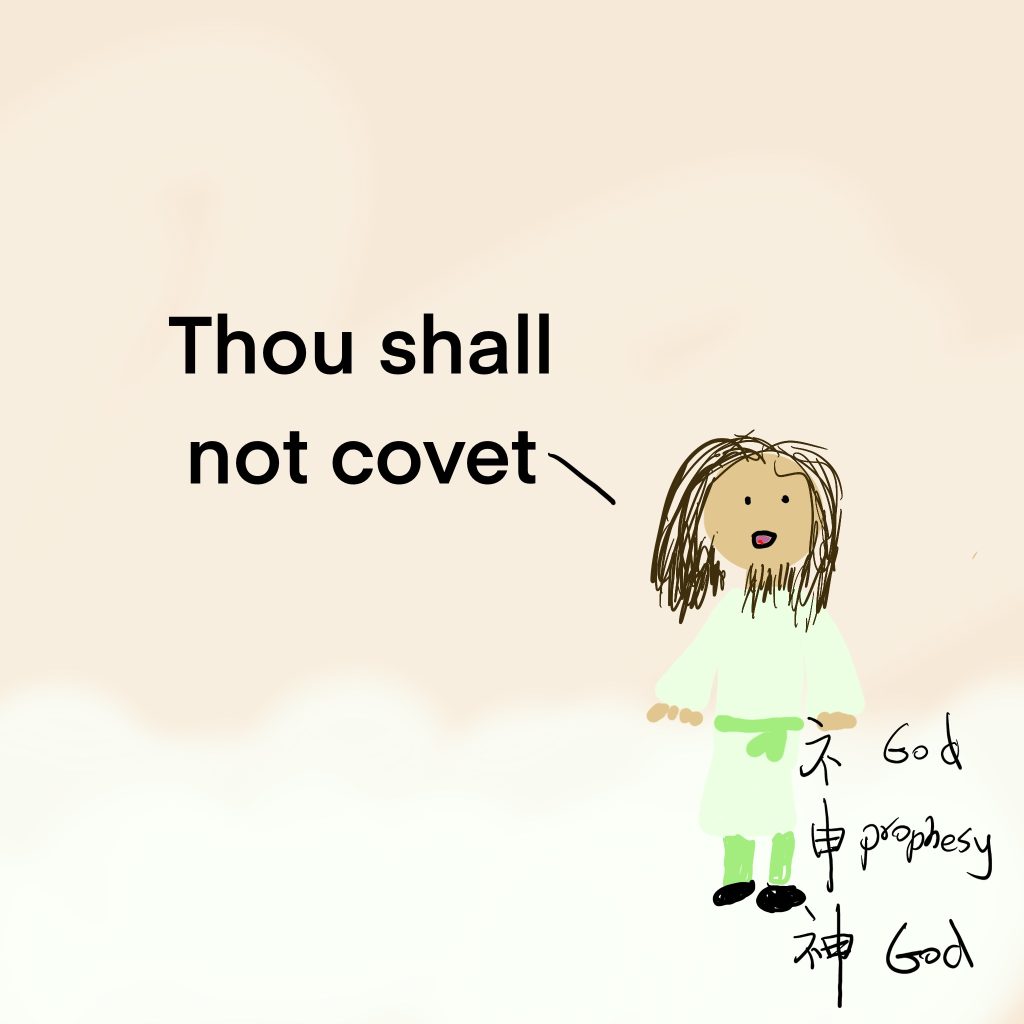
There are many more examples than I can include in this short post. I am actually writing a book together with my daughter. She is drawing the illustrations as I tell the story of the connections between Chinese characters and the stories of the Bible.
Sean Song is the founder and owner of Translation Boulevard, a professional translation service Washington DC based company, doing business for individuals and companies across the nation and around the world. He is also a writer who shares fascinating insights on language, culture, and the Bible. Supporting his translation services enables him to create more engaging content and stories like this one. To learn more about his nonprofit work, you can visit his ministry website at www.jbwm.org, where he shares his writings and teachings. Sean also leads Jairus Bible World Ministries (JBWM) and hosts the popular podcast Bible Study With Jairus.