
As a professional translation service, we understand the importance of broadening one’s horizons and learning more about different cultures and languages. Roughly 250 million people speak East Slavic languages, of whom around 50 million speak Ukrainian worldwide, making it the second-most-spoken Slavic language. Ukrainian is known for its melodic sound and rich history, making it an interesting field of discovery for both translators and language enthusiasts alike.
Many Washington DC translation services handle Ukrainian and other Slavic languages, but you should always look for the most skilled linguists. Ukrainian language may sound beautiful, but it’s tricky and very idiomatic when it comes to translation; that’s why it’s best to opt for professionals with years of experience in the field.
So, what’s so special about the Ukrainian language that makes it stand out from the rest? Let’s review some interesting facts.
Ukrainian Is Old
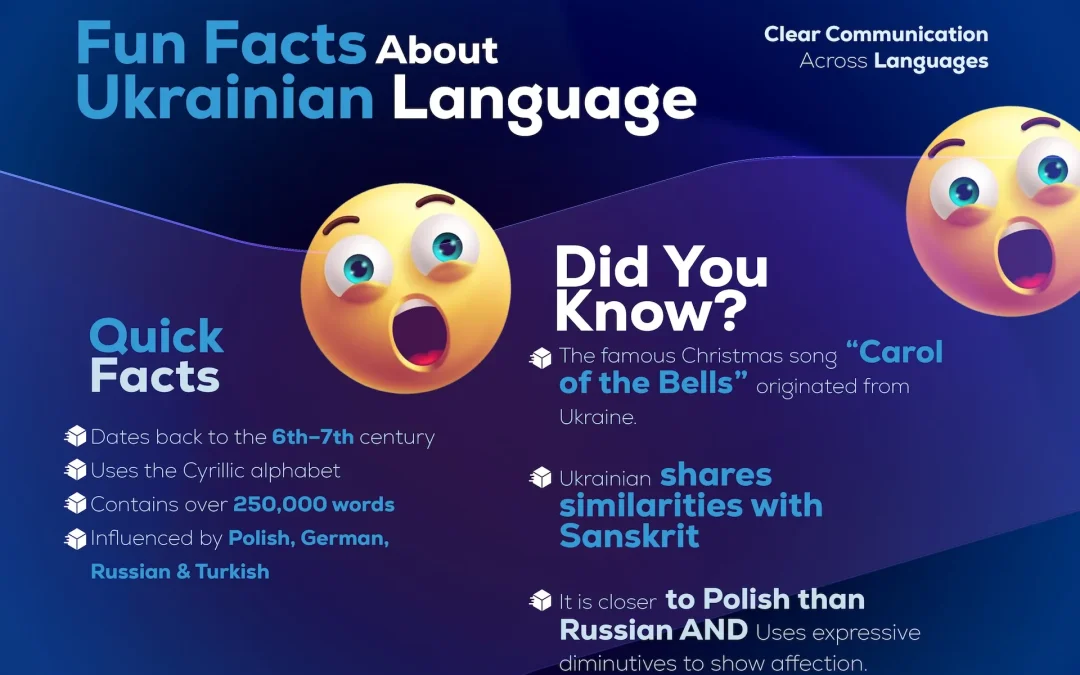
At our Washington DC translation service, we realize the importance of language history, as it plays a crucial role in understanding the cultural intricacies needed for high-quality translations. Hence, it’s important to know that the Ukrainian language dates back to the 6th-7th century AD when it existed as the Proto-Slavic language and was later shaped to sound closer to its modern variation in the 12th-13th centuries during the existence of the state named Kyivan Rus.
Modern-day Ukrainian uses the Cyrillic alphabet, comprises around 250,000 words, and is spoken not only in Ukraine but also in countries such as Hungary, Romania, Slovakia, and Poland. This language is rich with borrowed words from Polish, German, Russian, and even Turkish.
Ukrainian Has Similarities With Sanskrit
Sanskrit and Ukrainian belong to the Indo-European language group and share many similarities, preserving their respective archaic features. Although both languages are located in different parts of the world, they share common roots. In Ukrainian, you will find an abundance of words that sound nearly the same as their Sanskrit counterparts, sharing similar meaning, too. For example:
- Tata (Sanskrit) – Тато (Ukrainian) [Tato] – “Father”
- Chaya (Sanskrit) – Чай (Ukrainian) [Chai] – “Tea”
- Bhrata (Sanskrit) – Брат (Ukrainian) [Brat] – “Brother”
- Vidgva (Sanskrit) – Вдова (Ukrainian) [Vdova] – “Widow”
- Mata, matri (Sanskrit) – Матір (Ukrainian) [Matir] – “Mother”
- Nabha (Sanskrit) – Небо (Ukrainian) [Nebo] – “Sky”
Scholars have been studying the ties between Sanskrit and Ukrainian for years. They’ve explored archaeological finds, seeking shared ethnic, linguistic, and mythological details in Ukrainian folk culture and ancient Indian Vedic texts. To learn more about multilingual translation, contact our Washington DC translation service, and we will aid you with your project or business.
“Carol of the Bells” Came from Ukraine
Thousands of people around the world enjoy the famous song “Carol of the Bells” during the Christmas season, but few know that it originated in Ukraine. Its original title is “Shchedryk”, meaning “bountiful”, and the song itself comes from the pagan ritual songs from ancient Ukraine. Singers gathered in small groups to perform this song on Christmas Eve, praising the host and wishing prosperity to their household.
In 1916, Ukrainian composer Mykola Leontovych took this simple song and wrote a choral masterpiece based on its one-voice melody. Having gained immense popularity in both Europe and the U.S., the song got its English lyrics in 1936, becoming the world-famous Christmas anthem “Carol of the Bells” we all know and enjoy today. The song was featured in such popular movie franchises as Home Alone, Die Hard, and Harry Potter.
Surzhik: the Mix of Russian and Ukrainian
While the majority of Ukrainians prefer to speak either Ukrainian or Russian, there’s also a phenomenon called “surzhik” when the two languages get mixed. The basis of this language is still Ukrainian, but with slight alteration – mostly the grammar is the same, but the words may be borrowed extensively from the Russian language. As a result, people may speak a peculiar, sometimes funny-sounding dialect.
“Surzhik” originated among the country’s rural population and is commonly found in regions neighboring Russia, Moldova, and Poland. According to statistics, up to 18% of the country’s population speaks “surzhik”, which is approximately 8 million people.
For more information about Russian, Ukrainian, and other languages, feel free to contact our Washington DC translation services.
Ukrainian Is Closer to Polish
Despite Ukraine’s geographical proximity to Russia, the Ukrainian language has more similarities to Polish, its other neighbor, which has always had a significant influence on Ukrainian phonetics and lexicon. The vocabulary of both languages overlaps significantly, to the point that Ukrainian speakers can understand Polish even without learning it (though they wouldn’t be able to speak it due to grammatical differences).
There’s a general misconception that all East Slavic languages are somehow aligned with each other, but that’s not true. Russian speakers wouldn’t understand people from Poland, and would have a hard time understanding Ukrainians if they haven’t learned the language specifically before. Contact our Washington DC translation service if you have any questions about translating Ukrainian and other East Slavic languages.
Ukrainian Generously Uses Diminutives
Ukrainians love to use diminutives – word forms that convey familiarity, affection, or smallness. These are not exclusive to names and can be applied to nouns as well. Just like in English, people would transform the word ‘cat’ into ‘kitty’, Ukrainians would transform the word ‘кіт’ (kyt) into ‘котик’ (kotyk).
In English, we can say ‘mommy’ instead of ‘mother’ to sound cuter, while in Ukrainian, we can say ‘матуся’ (matusya) instead of ‘мама’ (mama). Diminutives not only add cuteness to the language but also convey subtler meanings, such as humor or sarcasm.
Conclusion
Ukrainian is the second most spoken East Slavic language, boasting a rich history and a peculiar connection to Sanskrit, with words that share phonetics and meanings. Its vocabulary comprises more than 250,000 words, many of which were influenced by the neighboring countries.
If you’re looking for multilingual translation, be it Ukrainian, Russian, or any other language, contact our Washington DC translation service. Our team of qualified linguists provides a wide range of translation and interpretation services to match all your business and personal needs at affordable prices.